
Which Draper Records Are Open
Utah's Government Records Access and Management Act, known as GRAMA, classifies a government record as public, private, controlled, or protected. A name in a file does not close it by itself. The record's type and any more specific law decide access. Draper city material goes to the City Recorder, while county land and tax files follow the parcel. Courts are state-run. Recent vital certificates use a separate eligibility system.
| Record set | Keeper | Web access | Access route |
|---|---|---|---|
| City actions, permits, plans | Draper City Recorder | City search and request hub | Online record or city GRAMA request |
| Deeds, liens, plats | Parcel's county recorder | Salt Lake paid service; Utah County free library | Portal, office copy, email, or phone |
| Owner, parcel, value, GIS | Parcel's county assessor | Free in both counties | Owner, address, parcel, or map search |
| District and justice cases | Utah State Courts | Xchange | Paid web search, free terminal, or clerk |
| Birth, death, marriage, divorce | State, health department, county clerk, or court | No open current-person index | Eligible copy or historical archive |
| Police, jail, corrections | City police, county sheriff, or Utah Corrections | Separate request and locator systems | Portal, roster, records unit, or GRAMA |
Sealed and expunged matters, juvenile cases, adoption files, parts of family cases, protected voter data, and motor-vehicle personal data are not ordinary open searches. Recent birth and death certificates also require proof of eligibility and identity. Historical records can move to Utah State Archives once the governing closure period and series rules allow access.
Draper Records Cross County Lines
Draper's city boundary reaches into Salt Lake County and Utah County. Most residents and City Hall sit in Salt Lake County, but the southern Traverse Ridge area extends into Utah County. That split changes the recorder, assessor, district court, county clerk, health office, elections office, and jail that may hold a record. A Draper mailing address alone does not settle the issue.
Start with the property or event location. A parcel map can confirm the county before a deed or assessment search. Third District Court serves the Salt Lake County side, while Fourth District Court serves the Utah County side. The Draper City Recorder still keeps records created by the city, such as council packets, ordinances, agreements, development material, cemetery administration, and municipal requests.
Three recorder roles. Draper's City Recorder keeps municipal files. The two county recorders keep land instruments, while county clerks handle marriage licenses and elections.
Note: Draper follows the Salt Lake address grid even inside Utah County, so a familiar grid address does not prove county jurisdiction.
Draper Land Records, Two Systems
The county line creates a sharp access difference. Salt Lake County's free assessor can identify an owner, address, and parcel number, but the Recorder's richer Data Services tools require login and metered units. The products include recorded documents, chain of title, legal descriptions, tract indexes, subdivision maps, and plat maps. The official research did not establish a public online start year, so older-date coverage should be confirmed with the office.
The Salt Lake County Recorder Data Services page shows the paid land-record products available for the Salt Lake County side of Draper.
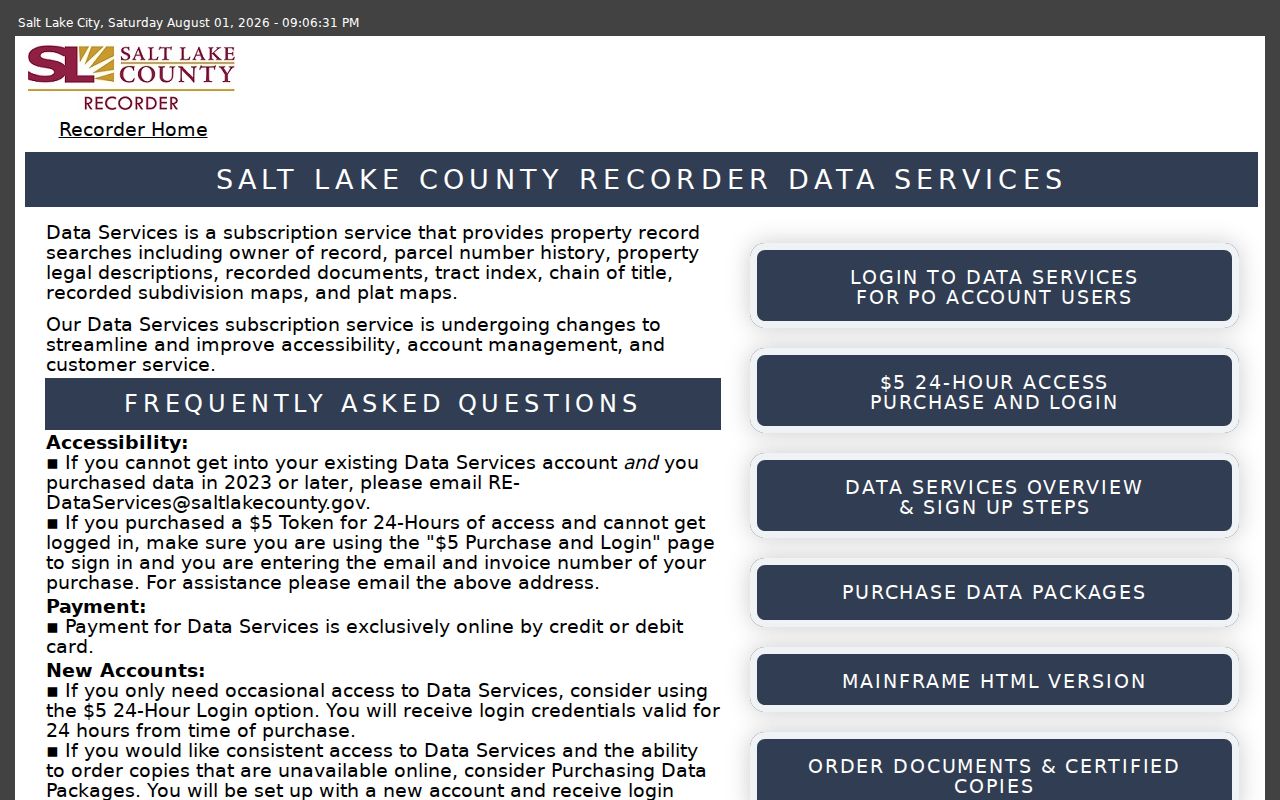
The screen is the entry to a subscription service, not proof that a named deed or its image is available for a given year. A 24-hour package with up to 150 data units is listed at $5. Counter and email copy routes remain available through the recorder.
Utah County takes a different approach. Its free land-record library includes official records from 1870 forward, a handwritten alphabetical index through January 1978, a computerized index after that point, and online abstracts beginning in May 1980. Books, scans, ownership plats, subdivision plats, entry-to-parcel links, party names, instrument types, mining, and water-right searches provide several paths when one field fails.
Draper Records in Utah County
The Utah County owner form expects a name in LAST, FIRST MIDDLE order, though a surname alone is accepted. It can include all records, current records only, or never-valid records. Recorded-document searches can instead use party name, an instrument code, an entry number with year, or a recording date range. These fields make the portal useful even when an old Draper deed lacks a modern street address.
| Search field | Input | Use |
|---|---|---|
| Enter Name to search for | Text, required | LAST, FIRST MIDDLE; surname accepted |
| Record status | Radio choice | All, current, or never-valid records |
| Party Name | Text, required in party mode | Find a grantor or grantee |
| KOI Group | Dropdown | Limit by kind of instrument |
| Entry Number and Year | Paired text | Retrieve a known recording |
| Recording Date range | Date pair | Browse recordings within dates |
The Utah County owner-name search displays the name pattern and record-status filters.
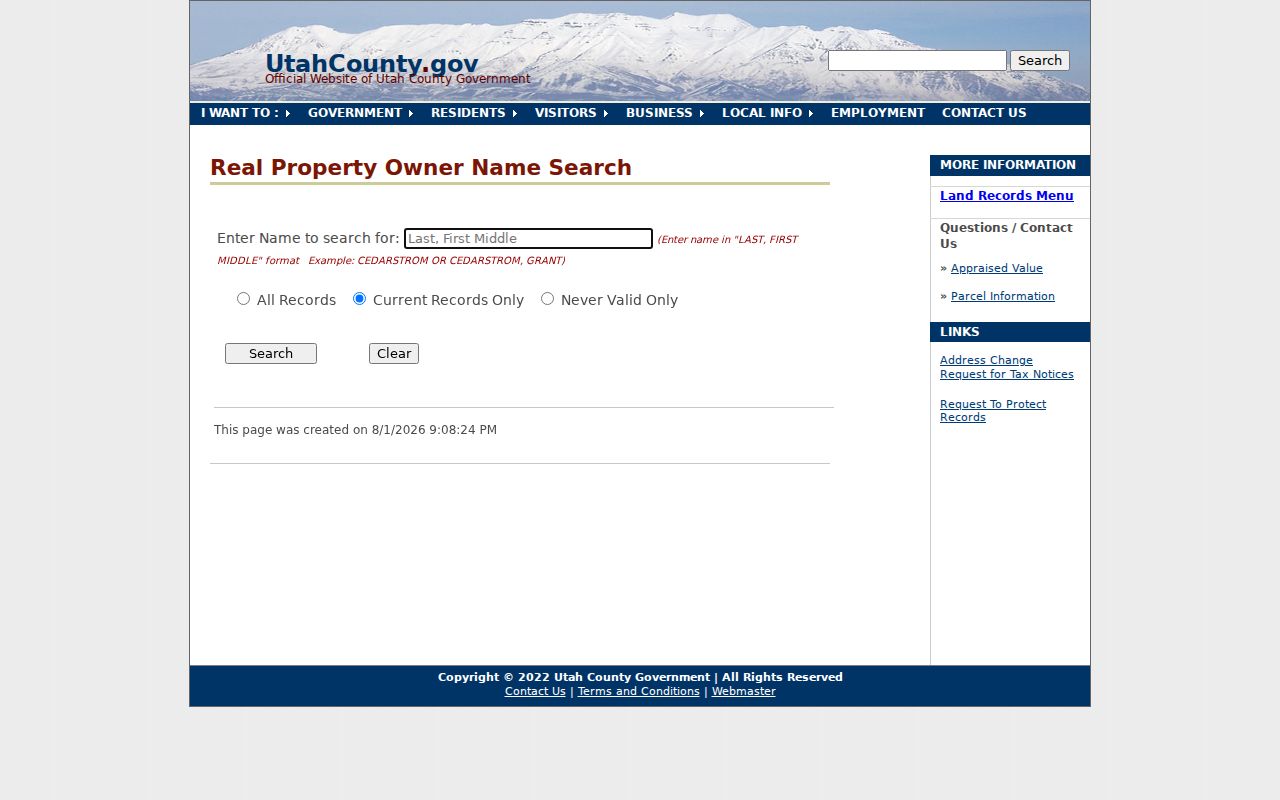
Its controls help separate a current ownership result from an older or never-valid parcel record. The companion Utah County address search breaks an address into structured parts.
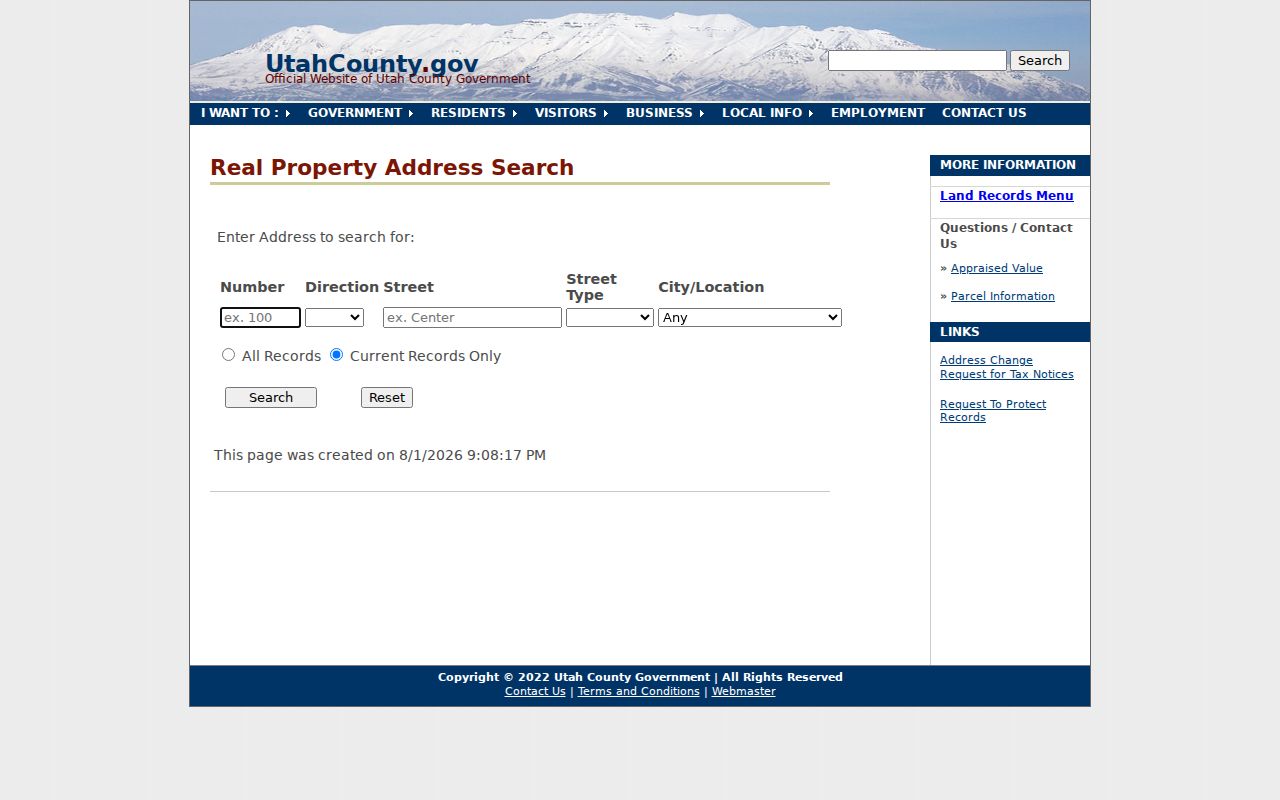
That form offers a practical fallback when an owner has changed but the street address remains known.
Draper Property Records and GIS
Both county assessors offer free owner, address, and parcel access. For Salt Lake County, the legacy form accepts an owner name with at least three letters, address parts, or a parcel ID. Individual owners use the format LAST, FIRST. A parcel ID can use its first ten digits, while the first seven can return a block. The modern page also offers address autocomplete and a full parcel-number format.
The Salt Lake County Assessor search form shows the owner, street, and parcel options used for most Draper parcels.
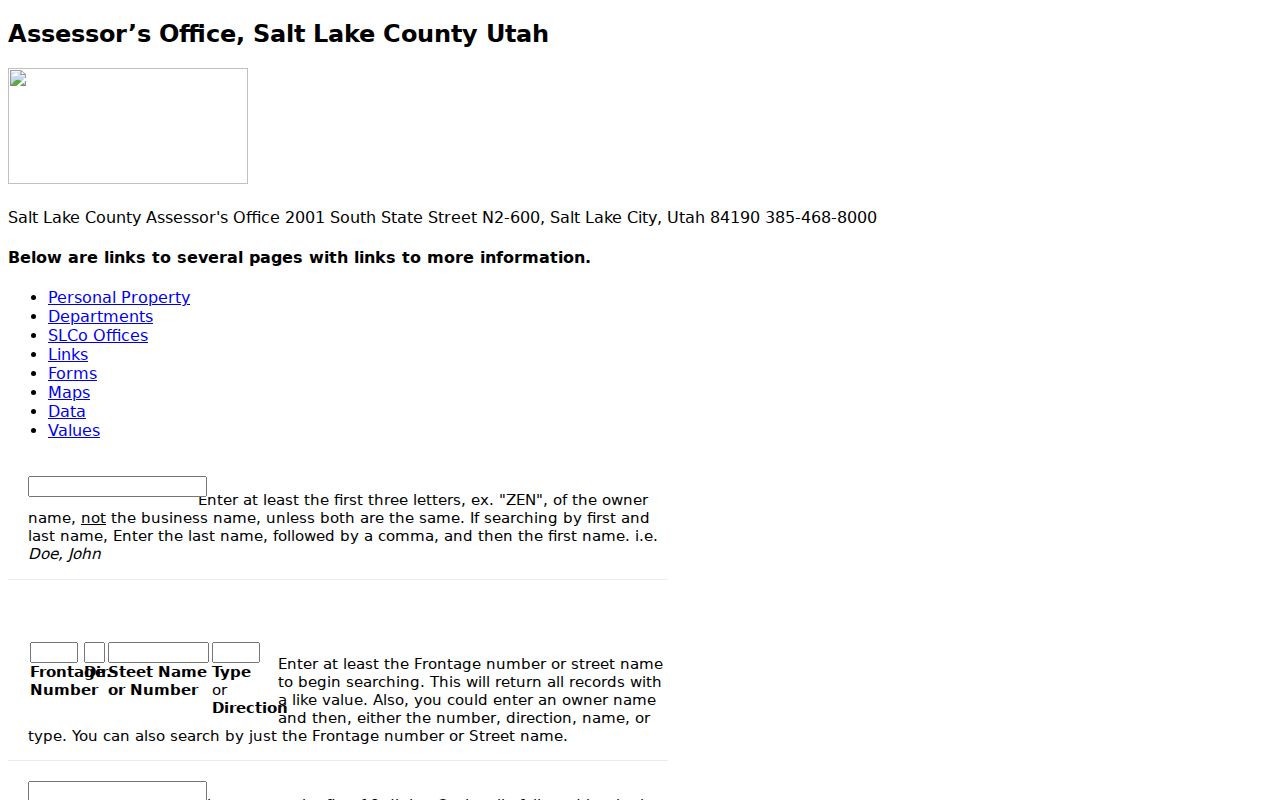
The form leads to assessment data, while the county GIS adds parcel geometry, map layers, imagery, and tax-district context.
Read each field carefully. A situs address is the property's physical location. A tax mailing address is where notices go, and a legal description defines the land without relying on a street name. Ownership does not establish who occupies a place. For a changed or missing address, use the parcel, recorded plat, legal description, or address affidavit rather than forcing a modern street label onto an older instrument.
Draper Court Records Through Xchange
Utah State Courts, not either county clerk, administer Draper's court files. Draper Justice Court hears city-level Class B and C misdemeanors, infractions, citations, and small claims. Third and Fourth District Courts hold the broader civil, criminal, family, and probate matters for their respective county sides. The statewide Xchange system searches public case information by case number, party or company name, jurisdiction, case type, county, court, and date range.
Results can show court location, case type, case number, filing date, party name and role, plus public docket events, attorneys, judgments, and eligible electronic documents. District data is generally complete from the end of 1998. Public district documents filed electronically since July 1, 2010 may be purchased. Results cap at 500, so common names benefit from a first name, date range, county, or direct case number.
Utah Courts' Xchange information describes guest and account access. Free terminals are available at most district courthouses and the Utah State Law Library, while the clerk supplies file copies and certified records. Sealed, expunged, adoption, juvenile, civil-commitment, and specified family-case details do not appear as ordinary results.
Note: A docket is a dated list of case events, not a finding that every allegation in a filing is true.
Draper Vital Records Have Boundaries
Current vital certificates are controlled records, not an unrestricted name index. Utah Vital Records and the event-county health department handle birth and death certificates from 1905 forward. County clerks issue marriage records, and district courts hold divorce decrees. The state can provide marriage and divorce abstracts for 1978 through 2010, but an abstract is not the full court decree.
Birth records become public after 100 years, death after 50 years, and marriage or divorce after 75 years, subject to the series and court rules. Before then, the person named, qualifying immediate family, a guardian, or a legal representative must show identity and the required relationship or legal need. Ordering routes include online service, mail, and an eligible in-person request through a local health department.
The Utah vital-record fee schedule lists fees effective July 1, 2026: $25 for a birth certificate or marriage/divorce abstract, $35 for a death certificate, and $10 for an additional copy of the same record. Older application PDFs showing $18 are superseded. Mail service can take at least three weeks, and the state reported a longer high-volume delay in June 2026.
Draper Police and Custody Records
Draper separates police and accident requests from non-police city requests. The Police Records Unit accepts its own online route and can be reached at 801-576-6300 on weekdays from 8 a.m. to 5 p.m. Active-investigation facts, victim data, juvenile material, and personal details may be classified or redacted. A narrow request should include the incident number if known, a date and time range, location, and involved person.
Custody information is split again. The Salt Lake County Sheriff provides a current roster and in-out docket. Utah County's inmate search supports a name, arrest date, or current-inmate browse, with results such as name, year of birth, date in, ID, status, booking details, and charges. Its own retention notices conflict on some time spans, so an older absence should not be treated as proof that no booking existed.
Utah Corrections Offender Search covers a person who is now incarcerated or supervised on probation or parole. It does not include unsentenced county-jail detainees. The statutory offender registry is another separate system, and its data may not be used to harass, stalk, threaten, or harm a registrant or family member.
Draper Public Records Offices
Use the office that created or keeps the target file. City Hall handles Draper municipal material and justice-court files. The county recorders handle deeds and plats, while assessors publish current parcel facts. Calls and counter requests are useful when a portal is gated, an old date falls outside the stated web range, or a certified copy is required.
Salt Lake County Recorder
2001 S State Street, Suite N1-600, Salt Lake City, UT
385-468-8145
Weekdays, 8 a.m. to 5 p.m.
Utah County Recorder
Land files for southern Draper parcels
801-851-8179
recorder@utahcounty.gov
Draper Justice Court
1020 E Pioneer Road, Draper, UT
801-576-6540
Weekdays, 8 a.m. to 5 p.m.
Salt Lake Recorder copies are listed at $2 per recorded page, $5 per vault page, and $5 for certification plus copy charges. The office also accepts questions by email at RecorderQ@saltlakecounty.gov. Utah County's online library and images are free, with office copy and certification routes available when a web image is not enough.
Draper Records Terms Made Clear
A portal result can locate a file without supplying the full evidence. These terms mark the difference between finding an entry, reading its contents, and obtaining an official copy.
- Custodian
- The government office responsible for keeping and responding for a record.
- Index
- A searchable list of names, dates, numbers, or record types that points to a source file.
- Image
- A scan of the filed document. It can show terms and signatures that the index leaves out.
- Certified copy
- A copy carrying the custodian's official certification for a formal need.
- Exemption
- A law-based reason to withhold all or part of material that would otherwise be requested.
Inspection, a plain copy, and certification solve different needs. A free index or terminal can identify the right item. A plain copy shows content. Certification adds official proof. During broad research, note the entry, case, parcel, or permit number first so that any paid order targets the correct file.
The Utah State Archives research portal is the main fallback for older state, county, city, school, court, and special-district series.
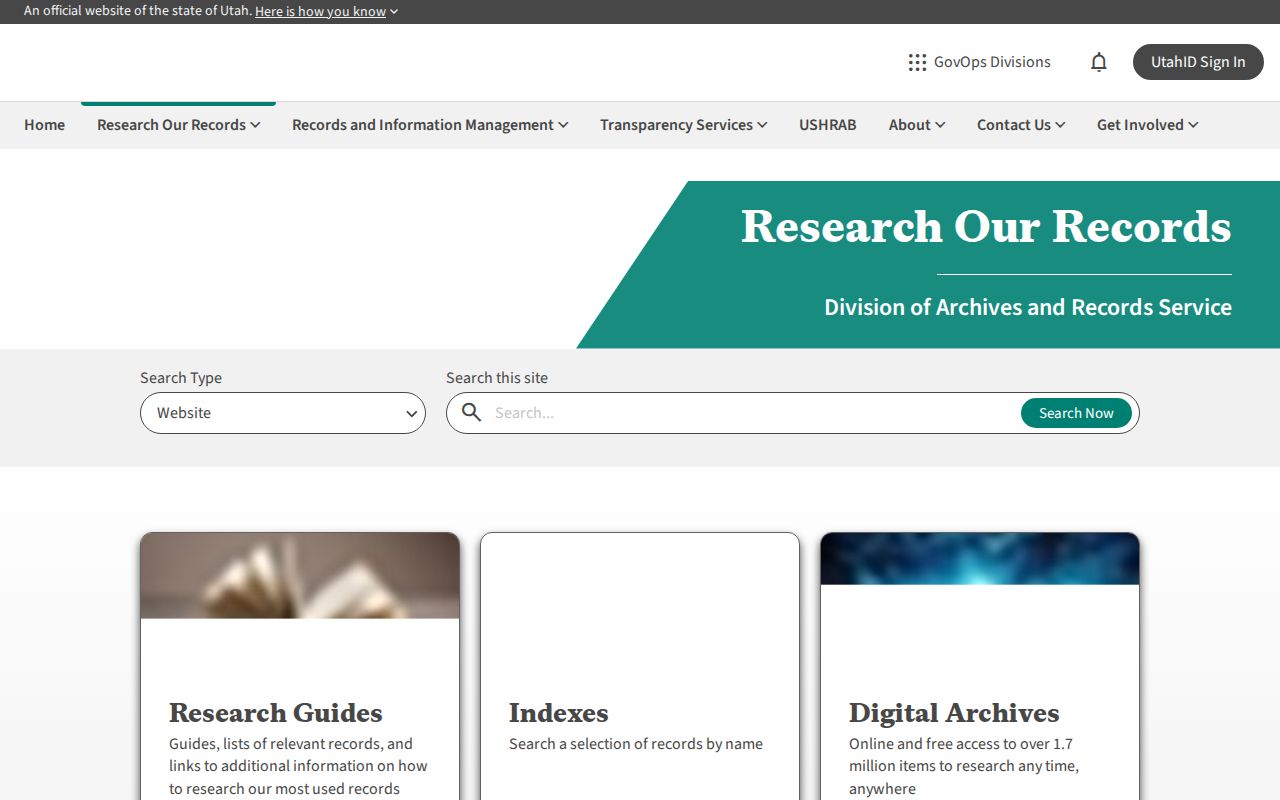
The archives catalog is especially relevant when an electronic court, deed, or vital system begins later than the event being researched.
Draper GRAMA Timing and Costs
GRAMA allows any person to ask for an existing government record without a Utah residency rule. An ordinary response is due as soon as reasonably possible and generally within ten business days. A five-business-day track applies only when expedited disclosure demonstrably benefits the public rather than the requester alone. Extraordinary circumstances can extend the date, and no timely response is treated as a denial.
An entity may charge the reasonable actual cost of search, compilation, formatting, copies, and an incremental electronic service. The hourly rate cannot exceed the lowest-paid employee qualified to do the work. The first 15 minutes of staff time are generally free, subject to the serial-request rules. Classification review itself is not billable. Draper's April 2025 schedule lists ordinary pages at $0.15, larger pages at $0.50, and a GRAMA CD at $15, but the current consolidated schedule should control.
Utah agencies need not create a new answer, analysis, or custom file. Ask for records that exist, request their native electronic format when available, and seek a cost estimate before chargeable work. A fee waiver may be granted for primary public benefit, for the subject or authorized representative, or when an impecunious requester needs records tied to legal rights, but the waiver is discretionary.
Note: A portal screenshot is not a certified copy, and paying for certification is usually unnecessary until the exact record has been identified.
Request Draper Public Records
A strong records request names a keeper and describes a file, not a broad question. Under Utah Code §63G-2-204, give the requester's name, mailing address, an email when used or accepted, daytime phone, and a reasonably specific description. Draper's city hub separates police from non-police requests. Land-document copies should use the appropriate county recorder channel rather than asking city staff to conduct title research.
- Identify who holds the record. Resolve the county for land, district-court, election, jail, or health material, and use the City Recorder for city-created files.
- Check the official index or catalog. Save the case, parcel, entry, document, incident, permit, or archive-series number that will narrow the request.
- Describe the existing file and date range. For permits, include the address and requested parts. For police reports, add the incident details and expect lawful redactions.
- Choose inspection, electronic delivery, plain copy, or certified copy. Ask for an estimate before staff research or copy charges accrue.
- Respond to a denial or no-record notice. Narrow the wording, follow a custodian referral, or appeal first to the entity's chief administrative officer.
A further appeal may proceed to the State Records Committee, Government Records Office, or district court as allowed. The Government Records Office also provides ombudsman help at 385-227-1226. Keep the request, response, cited classification, fee estimate, and delivery date together.
Lawful personal use. Open access does not permit stalking, threats, intimidation, or harassment. Utah law and each portal's limits still govern how a record may be used.